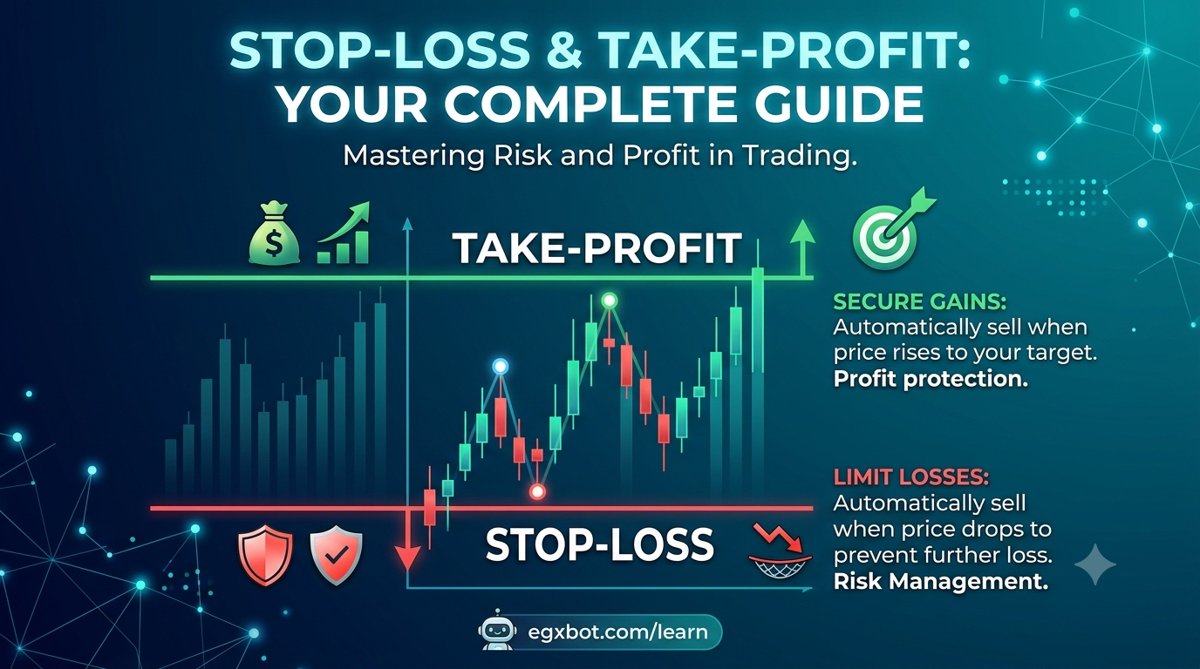
Stop loss is an automatic sell order that limits your losses if the stock falls below a certain level, while take profit is a sell order at a predetermined profit target. In EGX, it is recommended to set a risk percentage of 2-3% per trade and place stop orders immediately upon entry.
Introduction
In the world of trading on the Egyptian Exchange (EGX), identifying entry and exit points is one of the most important skills for any beginner investor. Without a clear risk management strategy, profits can quickly turn into large losses. This is where two essential tools come in: Stop Loss and Take Profit. In this article, we will explain everything you need to know about these tools in a simple way with real examples from the Egyptian market.
What is Stop Loss and Take Profit?
A stop loss is an order you place in advance to sell a specific stock when its price reaches a certain level below your purchase price, aiming to limit losses if the market moves against your expectations. A take profit is a sell order at a specific price level above your purchase price to lock in profits before the trend reverses.
Simply put, they are automatic orders that ensure you exit the trade at a predetermined price, removing emotion from trading decisions.
Why Does It Matter in EGX?
The Egyptian Exchange is characterized by sharp fluctuations sometimes due to local economic and political news, in addition to being affected by global markets. Without a stop loss, a 2% loss can turn into 10% overnight. Also, take profit helps you secure your gains in a market where short-term direction is hard to predict. Using these tools makes you a disciplined trader, which distinguishes professionals from amateurs.
How to Apply Step by Step
- Determine entry price: Choose the stock and price to enter. For example, you bought TMGH shares at EGP 10.
- Set risk percentage: Decide in advance the loss percentage you can tolerate. For beginners, 2-3% per trade is recommended.
- Calculate stop loss: If you tolerate a 2% loss, set stop loss at EGP 9.80 (2% below 10).
- Set profit target: Determine the target profit percentage, e.g., 5%, so take profit at EGP 10.50.
- Enter orders: On the trading platform, add stop loss and take profit orders at the same time you open the trade.
- Don't change orders unless strong reason: Avoid moving stop loss further away due to fear or greed.
Example from EGX
Suppose you bought 100 shares of COMI (Commercial International Bank) at EGP 40 per share. You decided the acceptable risk is 3%, and profit target is 6%.
- Stop loss: 40 * (1 - 0.03) = EGP 38.80. If price drops to 38.80, shares are sold automatically for a loss of EGP 120 (3% of 4000).
- Take profit: 40 * (1 + 0.06) = EGP 42.40. If price rises to 42.40, you sell for a profit of EGP 240.
Note: Ensure levels are supported by technical support/resistance if possible. For example, if there is support at EGP 39, you might place stop loss just below it.
Common Mistakes
- Setting too tight stop loss (e.g., 0.5%), leading to early exit before a minor correction.
- Never using stop loss, relying on hope to recover losses.
- Moving stop loss downward after loss to avoid activation, increasing losses.
- Setting take profit too low, missing larger gains.
- Ignoring liquidity: in low-liquidity stocks (some EGX stocks), stop loss may not execute at exact price (slippage).
Advanced Tips
- Use trailing stop loss to let profits ride with the uptrend.
- Analyze support and resistance levels before setting stop orders. For instance, if SWDY stock has support at EGP 5, place stop loss at EGP 4.90.
- For beginners: start with small risk percentage (1-2%) until you get used to it.
- Remember stop loss is not always guaranteed in fast markets (gap down). Monitor important news.
- Use "Stop Limit" orders instead of "Stop Market" to avoid negative slippage.
Summary
Stop loss and take profit are indispensable tools for risk management in the Egyptian Exchange. They help protect your capital and achieve consistent profits without being influenced by emotions. Start by setting an appropriate risk percentage, and use examples like COMI to apply the concept. Remember that discipline is the key to trading success.
Frequently asked questions
What is the difference between stop loss and take profit?
Stop loss limits losses when the stock moves against your prediction, while take profit locks in profit at a specific price level.
Can I modify stop loss orders after opening the trade?
Yes, you can modify or cancel them anytime, but it's better not to change them except for a strong technical reason (e.g., new analysis).
How do I choose the right stop loss level?
You can use technical analysis (e.g., support/resistance levels) or set a fixed percentage (e.g., 2-3% of entry price).
What happens if the stock gaps down below my stop loss?
The order will be executed at the best available price after the gap, and the loss may be larger than expected due to slippage.
Is trailing stop loss recommended for beginners?
It can be used after gaining some experience, as it requires continuous monitoring and may lead to early exit if the market moves quickly.
What is the appropriate risk percentage for a beginner in EGX?
It is recommended not to exceed 1-2% of capital per trade to protect the portfolio from large losses.
Apply it with egxbot
Get real-time analysis, signals and a bilingual AI assistant for Egyptian Exchange stocks — free to start.
Start free on Telegram