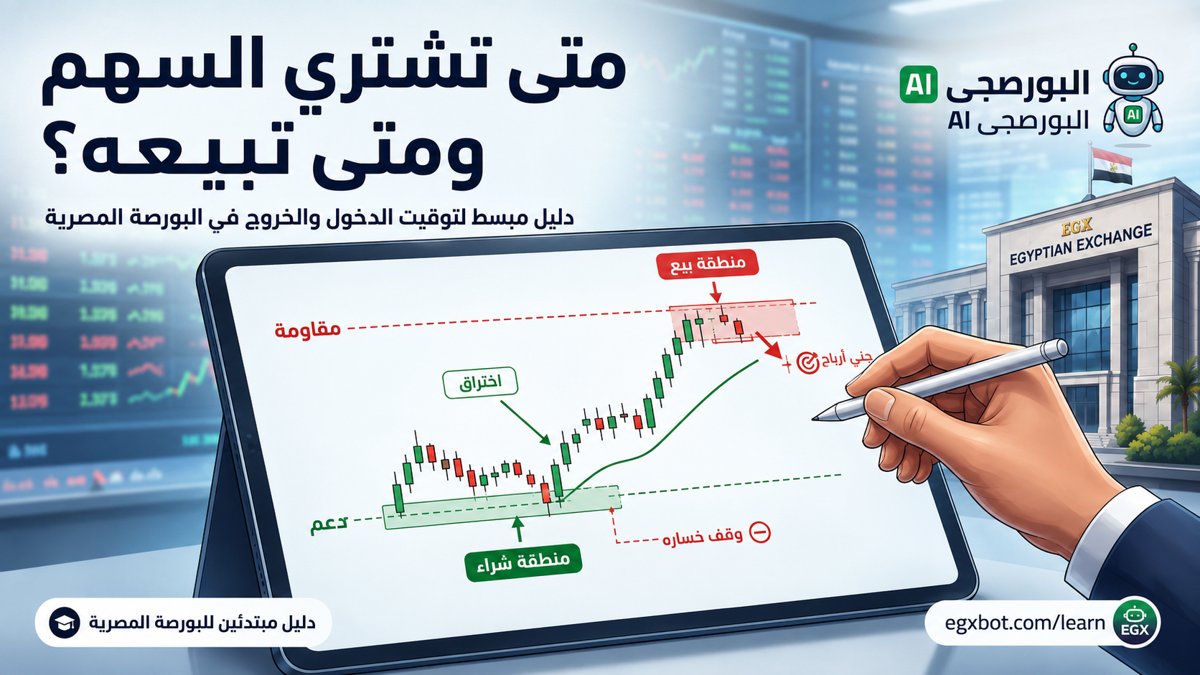
Buy a stock when price reaches a logical support zone or breaks resistance with clear trend, suitable volume, and a favorable reward-to-risk ratio. Sell when price reaches a planned target, shows weakness near resistance, or breaks the level that invalidates the trade. Do not buy only because a stock fell or sell only because of fear; use a written plan.
“When should I buy a stock and when should I sell it?” is one of the most important questions for any trader or investor. Many decisions are made emotionally: buying after a strong rally because of fear of missing out, or selling during a normal pullback because of fear.
A good decision should not depend on emotion alone. It should be based on a clear plan that combines price, trend, support and resistance, volume, stop-loss, and target. This guide turns buying and selling into practical steps.
Start with a Plan Before Asking Whether to Buy
Before asking “Should I buy now?”, ask: Why am I buying? Where will I exit if the trade works? Where will I exit if it fails? Without these answers, the trade is random even if the stock looks attractive.
- Define the reason for entry: support, breakout, rebound, results, or trend.
- Define the stop-loss before buying.
- Define the first target or profit-taking area.
- Calculate position size based on risk.
- Make sure the reward-to-risk ratio is acceptable.
A good buy is not simply the cheapest price. It is a point where potential reward is greater than potential loss.
When Should You Buy a Stock?
1. Buying Near Clear Support
Support is a price area where demand previously appeared and price bounced more than once. Buying near support may reduce risk because the stop-loss can be placed close below the zone.
However, touching support is not enough. It is better to wait for evidence of buyers, such as a rejection candle, clear rebound, improving volume, or a reclaim after a temporary break.
Simple Example
If a stock trades between support at EGP 18 and resistance at EGP 21, and it has bounced from the EGP 18 area several times, the zone may be worth watching. If price rebounds from EGP 18.10 to EGP 18.60 with good volume, a trader may consider entry with a stop below support, such as EGP 17.70.
2. Buying After a Resistance Breakout
Resistance is a level where price previously failed to move higher. When the stock breaks above that level with a clear close and strong volume, buyers may be gaining control.
A higher-quality breakout usually includes:
- A clear resistance level tested more than once.
- A close above resistance, not only an intraday wick.
- Volume above average.
- Price does not quickly fall back below the breakout level.
- A realistic target that offers enough reward.
3. Buying After a Successful Retest
After a breakout, price may return to test the broken resistance. If that resistance turns into support and price rebounds, this may offer a calmer entry than buying the initial surge.
This approach helps avoid chasing price, but not every breakout returns for a clean retest.
4. Buying with the Main Trend
Buying is generally stronger when it aligns with the broader trend. In an uptrend, price forms higher highs and higher lows, making pullback buys or breakout buys more logical than trading against the trend.
Moving averages such as the 50-day or 200-day average can help identify direction, but they should not be used alone.
5. Buying After Improved Fundamentals or Important News
Sometimes the reason to buy is fundamental rather than purely technical, such as earnings growth, lower debt, revenue expansion, or a major business development. In this case, combine fundamental strength with a reasonable technical entry.
Do not buy only because of news after a very large price move. Wait for calmer price action, a retest, or a logical entry point.
When Should You Avoid Buying?
- Do not buy only because the stock has fallen sharply.
- Do not buy after a strong rally without a plan.
- Do not buy if the stop-loss is too far and risk becomes excessive.
- Do not use all capital in a low-liquidity stock.
- Do not buy based on rumors or recommendations without analysis.
- Do not buy if you do not know where you will sell.
When Should You Sell a Stock?
1. Selling at the Planned Target
If you entered with a plan and placed a target near resistance or an important technical level, it is logical to take partial or full profit when price reaches that area.
Greed causes some traders to ignore predefined targets, and unrealized gains may later disappear. A balanced approach is to sell part at the first target and manage the rest with a trailing stop if the trend continues.
2. Selling Near Strong Resistance
When price reaches strong resistance after a rally, selling pressure may appear. This does not guarantee a decline, but it is a reason to watch price behavior closely.
- Long upper candle wicks.
- Repeated failure to close above resistance.
- High volume without further price progress.
- Negative divergence on momentum indicators.
- Break of a short-term higher low after reaching resistance.
3. Selling When the Stop-Loss Breaks
A stop-loss is not a sign of failure. It is a capital-protection tool. If price reaches the invalidation level defined before entry, the plan should be followed.
One of the biggest mistakes is saying “I will wait a little longer” after the stop is broken. Sometimes price recovers, but repeating this behavior can turn small losses into large ones.
4. Selling When the Original Reason for Buying Changes
If you bought because of earnings growth and then results weaken over several periods, or bought a breakout and price falls back below the breakout level, the original trade idea has changed.
Ask yourself: If I did not own the stock today, would I buy it again under the same conditions? If the answer is no, it may be time to reassess.
5. Selling to Rebalance the Portfolio
A stock may rise until it becomes too large a percentage of your portfolio. Even if the stock is profitable, selling part of the position may reduce dependence on one company or sector.
Trader Exit vs Investor Exit
| Factor | Trader | Investor |
|---|---|---|
| Reason for buying | Technical setup or short/medium-term momentum | Business quality, growth, and valuation |
| Reason for selling | Target, stop-loss, or momentum weakness | Deteriorating fundamentals, excessive valuation, or better opportunity |
| Time horizon | Days to weeks or months | Months to years |
| Main tool | Chart and risk management | Financial statements and valuation |
A common mistake is entering as a trader and, after a loss, saying “I will become an investor.” Do not change the nature of the position after it goes wrong. Define from the start whether it is a trade or an investment.
Using Reward-to-Risk Ratio
Before buying, compare potential profit with potential loss. If entry is EGP 20 and stop-loss is EGP 19, you risk EGP 1. If the target is EGP 22, the potential reward is EGP 2, producing a 2:1 ratio.
| Entry | Stop-Loss | Target | Risk | Reward | Ratio |
|---|---|---|---|---|---|
| 20 | 19 | 21 | 1 | 1 | 1:1 |
| 20 | 19 | 22 | 1 | 2 | 2:1 |
| 20 | 19 | 23 | 1 | 3 | 3:1 |
The target must be realistic and based on price structure, not optimism.
Practical EGX Example
Assume a stock is in an uptrend with clear support at EGP 14.50 and resistance at EGP 16. Price pulls back to EGP 14.70 and then rebounds with volume higher than previous sessions.
- Potential entry: EGP 14.80.
- Stop-loss: EGP 14.30.
- Risk per share: EGP 0.50.
- First target: EGP 15.80 to EGP 16.
- Potential reward: about EGP 1.
- Reward-to-risk ratio: about 2:1.
If price reaches EGP 16 and shows weakness, partial profit-taking may be reasonable. If it breaks above EGP 16 with strong volume, a trader may keep part of the position and raise the stop to protect profit.
This example is educational and does not represent a recommendation to buy or sell any security.
Signals That May Support Buying
- Clear rebound from important support.
- Breakout above resistance with a strong close.
- Successful retest after breakout.
- Improving volume during the move.
- Formation of higher lows.
- Broader uptrend on the higher timeframe.
- A clear target before major resistance.
- A reward-to-risk ratio near 2:1 or better.
Signals That May Support Selling
- Price reaches a planned target or strong resistance.
- Stop-loss or invalidation level is broken.
- Volume weakens during the rally.
- Reversal candles appear near highs.
- A short-term higher low is broken.
- Company results or news turn negative.
- Price becomes very extended above moving averages.
- The position becomes too large within the portfolio.
Common Buying and Selling Mistakes
- Buying because of fear of missing out: often leads to late entries.
- Selling because of panic: may lead to selling at temporary lows.
- Not defining a stop-loss: leaves loss open-ended.
- Ignoring the target: unrealized profit can disappear quickly.
- Following rumors: decisions should be based on data and price behavior.
- Turning a trade into an investment: often happens to avoid accepting a loss.
- Buying the full amount at once: staged entries can reduce timing risk.
Pre-Buy Checklist
- Do I know the reason for entry?
- Is the stock trending or moving randomly?
- Am I buying near support or after a confirmed breakout?
- Does volume support the move?
- Where is the stop-loss?
- Where is the first target?
- Is reward-to-risk acceptable?
- Is position size suitable for my capital?
Pre-Sell Checklist
- Has the stock reached the target?
- Is there strong resistance or clear weakness?
- Has price broken the stop-loss level?
- Has the original reason for buying changed?
- Am I selling because of a plan or because of fear?
- Should I sell part or exit fully?
- Does the portfolio need rebalancing?
Frequently Asked Questions
Should I buy a stock after a big decline?
Not always. A sharp decline may be an opportunity if the company is strong and support appears, but it may also be the beginning of a downtrend if the business is facing real problems. Wait for confirmation.
Should I sell as soon as I make a profit?
Not necessarily. It is better to sell according to a target, weakness signal, or profit-management plan. You may sell part and keep part if the trend remains strong.
Is it better to buy at support or after a breakout?
Buying at support often provides lower risk, while buying after a breakout provides more confirmation. The better choice depends on your trading style and risk tolerance.
Is a stop-loss always necessary?
For short- and medium-term trading, a stop-loss is essential for capital protection. For long-term investing, exit may be based on fundamentals, but risk limits are still needed.
How can I avoid selling too early?
Define your target before entry and use a trailing stop instead of exiting randomly. You can take partial profit and keep part of the position if the trend continues.
Conclusion
Buying and selling should be part of a plan, not an emotional reaction. Buy when the entry is logical, risk is defined, target is clear, and position size is suitable. Sell when price reaches your target, breaks invalidation, or the reason for buying changes.
No method can consistently identify the exact bottom or top. The real goal is to enter good zones, exit according to plan, and protect capital when wrong. Successful trading is not about one trade; it is about repeating disciplined decisions over time.
Stock trading and investing involve financial risk. This content is educational and does not constitute a recommendation to buy or sell any security.
Define Entry and Exit Before Placing the Trade
Use egxbot to monitor charts, support and resistance, trading volume, and price alerts so your buying and selling decisions follow a clear plan.
This content is educational and does not constitute a direct recommendation to buy or sell. Review risk, stop-loss, and position size before trading.
Apply it with egxbot
Get real-time analysis, signals and a bilingual AI assistant for Egyptian Exchange stocks — free to start.
Start free on Telegram