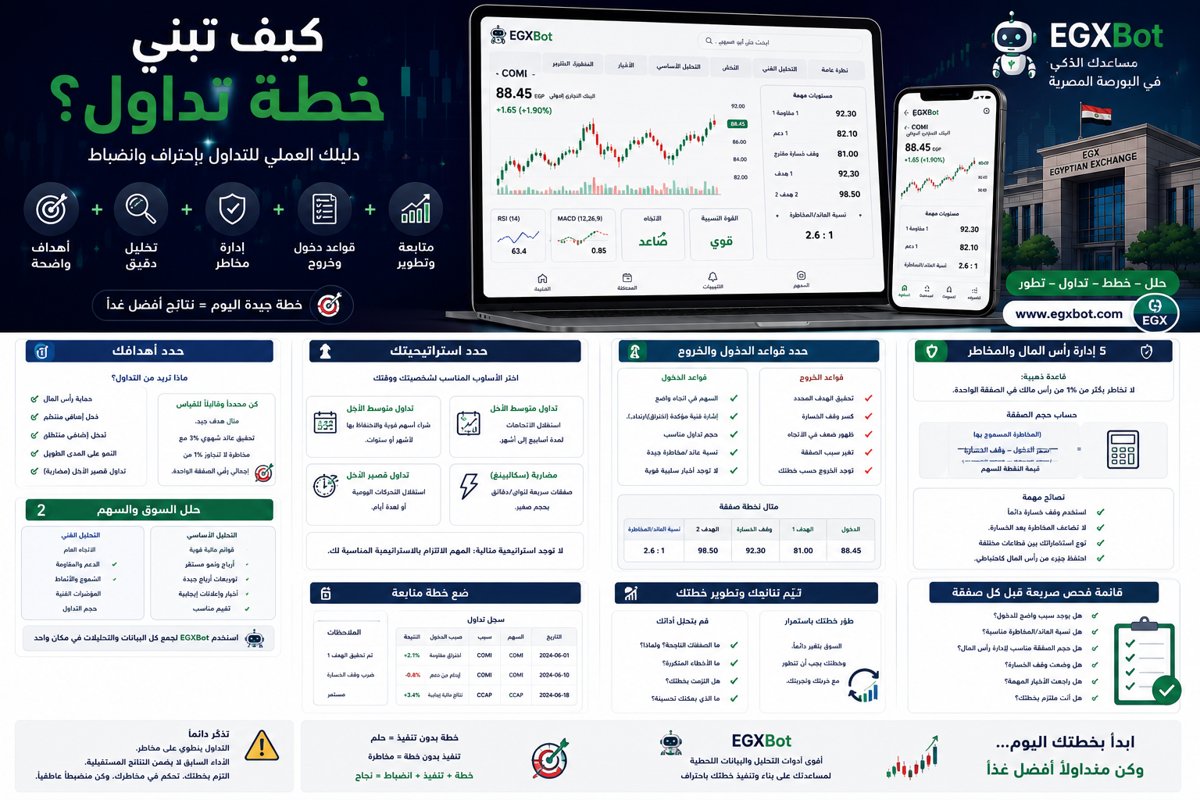
A good trading plan defines your goal, timeframe, stock selection rules, entry conditions, stop-loss, target, position size, and maximum risk. Before buying, you should know why you are entering, where you will exit if the trade works, and where you will exit if it fails. A written plan reduces emotional decisions and helps improve performance.
A trading plan is the difference between treating the market like a structured process and trading based on fear, greed, and random recommendations. Without a plan, you may buy because a stock is rising, sell because you panic, or increase position size because you want to recover a previous loss.
With a clear plan, you know in advance when to enter, why to enter, how much to risk, and where to exit if the trade works or fails. This does not guarantee profit, but it makes your decisions measurable and improvable.
What Is a Trading Plan?
A trading plan is a written set of rules that defines how you deal with the market. It includes the stocks you follow, timeframe, entry conditions, stop-loss, target, position size, and maximum acceptable risk.
A good trading plan answers key questions:
- What type of setups am I looking for?
- Which stocks are suitable for my style?
- When do I enter a trade?
- Where do I place the stop-loss?
- When do I take profit?
- How much do I risk per trade?
- How do I review my performance?
A plan does not prevent losses, but it prevents random losses. A losing trade within the plan is very different from a losing trade caused by impulsive entry.
Why Traders Need a Plan
Markets can change quickly, especially in active or low-liquidity stocks. Without clear rules, decisions are made under pressure. You may buy near a temporary top, sell near a temporary bottom, or turn a failed trade into a long-term investment.
A plan helps you:
- Reduce emotional decisions.
- Define risk before entry.
- Select only setups that match your style.
- Avoid chasing stocks after strong rallies.
- Know when to stop trading.
- Review mistakes and improve performance.
Step One: Define Your Trading Goal
Before building the plan, define why you trade. Are you looking for short-term trades, extra income, experience, or management of part of an investment portfolio? The answer changes stock selection, timeframe, and risk level.
| Goal | Suitable Timeframe | Main Focus |
|---|---|---|
| Short-term trading | Intraday to several days | Liquidity, momentum, support/resistance, news |
| Medium-term trading | Weeks to months | Trend, breakouts, earnings, trade management |
| Long-term investing | Months to years | Fundamentals, valuation, growth, dividends |
A common mistake is using short-term trading rules for an investment stock, or using an investment mindset to rescue a losing trade.
Step Two: Choose the Right Stocks
Not every stock is suitable for every trader. Some stocks are liquid and move smoothly, while others have weak liquidity and move in sharp jumps that make entry and exit difficult.
Stock Selection Criteria
- Daily liquidity suitable for your position size.
- Reasonable bid-ask spread.
- Clear price movement instead of completely random action.
- Support and resistance levels that can be analyzed.
- News and disclosures that can be monitored.
- No excessive dependence on one stock or sector.
Build a watchlist of 10 to 20 stocks instead of following the whole market. Less randomness usually leads to better decisions.
Step Three: Choose the Timeframe
The timeframe is the period used for analysis and decision-making. A day trader may watch shorter intervals, while a medium-term trader may focus on daily and four-hour charts. Investors often focus on weekly and daily charts.
- Use a higher timeframe to define the main trend.
- Use a medium timeframe to define entry and exit zones.
- Use a lower timeframe only to improve execution timing.
For example, if you trade over several days, you may define trend on the daily chart and refine entry on the hourly or four-hour chart.
Step Four: Define Clear Entry Rules
The reason for entry should not be a vague phrase like “the stock looks good.” You need specific conditions. If they are not present, you do not enter.
Examples of Technical Entry Conditions
- Rebound from clear support with good trading volume.
- Breakout above resistance with a close above it.
- Successful retest after breakout.
- Higher lows forming within an uptrend.
- Positive RSI or MACD signal aligned with price action.
- Improving volume during the upward move.
Example of a Written Entry Rule
Enter long if the stock is in an uptrend on the daily timeframe, pulls back to clear support, and shows a rejection candle or rebound with volume above recent sessions, provided that reward-to-risk is at least 2:1.
Step Five: Define Stop-Loss Before Entry
The stop-loss is the level that proves your trade idea is no longer valid. It must be defined before buying, not after the trade moves against you.
- Below clear support.
- Below the latest higher low.
- Below an accumulation or demand zone.
- Below the breakout level after a retest.
- Beyond the level that invalidates the full scenario.
Do not place the stop so close that normal noise removes you from the trade, and do not place it so far that the loss becomes unacceptable. If the logical stop is far away, reduce position size.
Step Six: Define the Target Before Buying
The target is the area where selling pressure, resistance, or a suitable profit-taking zone may appear. If you do not know where to sell if you are right, unrealized profit may turn into a loss.
Common Target Areas
- Previous resistance.
- Previous swing high.
- Liquidity area above price.
- Reward-to-risk level such as 2:1 or 3:1.
- Measured target from a clear chart pattern.
You can split targets: sell part at the first target and manage the rest with a trailing stop if the trend continues.
Step Seven: Calculate Position Size
Position size should not be random. Do not buy the same cash amount in every trade without considering the distance between entry and stop-loss.
Basic formula:
Number of shares = Risk amount ÷ Difference between entry price and stop-loss
Example
If your capital is EGP 100,000 and you decide to risk 1% on the trade, your risk amount is EGP 1,000.
- Entry price: EGP 20.
- Stop-loss: EGP 19.25.
- Risk per share: EGP 0.75.
- Number of shares = 1,000 ÷ 0.75 = about 1,333 shares.
- Approximate trade value = 1,333 × 20 = EGP 26,660.
If the share count is too large for the stock’s liquidity or your portfolio size, reduce the quantity. Risk control is more important than using all available cash.
Step Eight: Define Maximum Risk
Beginners should generally avoid risking more than 1% of capital in one trade. Also define maximum open risk across all trades, especially if they are in the same sector or depend on the same market direction.
| Risk Type | Beginner Rule | Purpose |
|---|---|---|
| Risk per trade | 0.5% to 1% | Prevent one trade from causing major damage |
| Daily or weekly risk | 2% to 3% | Prevent revenge trading |
| Total open portfolio risk | About 5% | Avoid excessive correlated trades |
| Sector exposure | Depends on portfolio size | Reduce sector-specific news risk |
Step Nine: Write Trade Scenarios
A good plan includes more than a bullish scenario. You should know what to do if price rises, falls, or moves sideways.
| Scenario | What Happens? | Your Action |
|---|---|---|
| Bullish | Stock breaks resistance with strong volume | Hold or gradually raise stop-loss |
| Bearish | Stock breaks the stop-loss level | Exit according to plan |
| Sideways | Stock does not move toward target | Review or reduce if the setup expires |
Writing scenarios reduces confusion during the session because you already know how to respond.
Step Ten: Manage the Trade After Entry
Some traders only plan entry, then do not know what to do after the trade is open. You must define how to manage winners and losers.
- If price reaches the first target, take partial profit.
- If price moves in your favor by the initial risk amount, consider raising the stop.
- If a strong reversal candle appears near resistance, review partial exit.
- If price breaks stop-loss, exit without moving the stop.
- If the stock does not move for a defined period, review whether the setup is still valid.
Step Eleven: Use a Trading Journal
A trading journal is a notebook or file where you record every trade: why you entered, where the stop was, where the target was, what happened, and whether you followed the plan.
Important journal fields:
- Trade date.
- Stock symbol.
- Reason for entry.
- Entry price.
- Stop-loss.
- Target.
- Position size.
- Result.
- Whether the plan was followed.
- Improvement note.
After 20 or 30 trades, the journal begins to reveal strengths and weaknesses. You may find that you perform better with breakouts, lose when chasing stocks, or exit profitable trades too early.
Ready-to-Use Trading Plan Template
| Item | What to Write |
|---|---|
| Trading goal | Short-term trading / medium-term trading / investing |
| Allowed stocks | Liquid stocks from a defined watchlist |
| Timeframe | Daily + 4H / Daily + 1H / Weekly + Daily |
| Entry rules | Support, breakout, retest, volume, trend |
| Stop-loss | Below technical invalidation level |
| Target | Resistance, previous high, or reward-to-risk level |
| Risk per trade | 0.5% to 1% of capital |
| Exit rules | Target, stop break, momentum weakness, scenario change |
| Review | Update the trading journal weekly |
Practical Example for an EGX Stock
Assume an Egyptian stock is in an uptrend and approaching resistance at EGP 18. The stock has good liquidity, and trading volume has started to increase in recent sessions.
Plan Before Entry
- Reason for entry: breakout above EGP 18 resistance.
- Entry condition: close above EGP 18 with volume above average.
- Potential entry: EGP 18.10.
- Stop-loss: EGP 17.40.
- Risk per share: EGP 0.70.
- First target: EGP 19.50.
- Reward per share: EGP 1.40.
- Reward-to-risk ratio: 2:1.
- Risk per trade: 1% of capital.
If the stock does not close above resistance, no entry is taken. If the trade is entered and price breaks EGP 17.40, the position is closed. If price reaches EGP 19.50, partial profit may be taken and the stop can be raised for the remaining quantity.
This example is educational and does not represent a recommendation to buy or sell any security.
Rules for Stopping Trading
A plan should not only define when to trade, but when to stop. Sometimes the best decision is to avoid new positions.
- After 3 consecutive losses, reduce size or pause for review.
- After losing 3% of capital in a week, stop opening new trades until mistakes are reviewed.
- If you feel the urge to recover losses immediately, stop trading.
- If the market is choppy and directionless, trade less.
- If you break your rules twice, review the cause before the next trade.
How EGXBot Can Help Build a Trading Plan
EGXBot can support each stage of the plan. Instead of manually searching for every detail, you can review technical analysis, support and resistance, volume, and alerts in one place.
- Use the live terminal to monitor charts and indicators.
- Review support and resistance before defining entry and stop-loss.
- Use price alerts instead of watching the screen all day.
- Ask the smart assistant about bullish and bearish scenarios.
- Review the portfolio to avoid excessive exposure to one stock or sector.
Common Trading Plan Mistakes
- Writing a plan that is too vague: “buy strong stocks” is not a rule unless strength is clearly defined.
- Not following the plan: a plan without discipline is only text.
- Moving the stop after entry: this often increases loss instead of protecting you.
- Using too many conditions: excessive complexity can create confusion.
- Not journaling trades: without records, you cannot know what works.
- Risking too much early: the beginning should focus on learning and capital protection.
- Ignoring overall market conditions: even good setups may fail in a weak market.
Pre-Trade Checklist
- Is this trade part of my plan?
- Is the stock on my watchlist?
- Is the reason for entry clear and written?
- Does the broader trend support the trade?
- Is volume suitable?
- Have I defined the stop-loss?
- Have I defined the target?
- Is the reward-to-risk ratio acceptable?
- Have I calculated position size?
- Do I have a plan if price moves against me?
Frequently Asked Questions
Is a trading plan necessary for beginners?
Yes. It is especially important for beginners because it reduces randomness and prevents excessive risk. A simple written plan is better than relying on feelings or recommendations.
Should the plan be complicated?
No. The best beginner plan is simple and clear: when to enter, where to place the stop, where to take profit, and how much to risk. It can be developed gradually after recording results.
What risk percentage is suitable per trade?
For beginners, 0.5% to 1% of capital per trade is usually more conservative. The key is to define the percentage in advance and apply it consistently.
Should I change the plan after several losses?
Do not change it randomly after every loss. Review the trading journal first. If losses come from poor execution, the issue is discipline. If losses come from weak rules, adjust the plan after enough trades.
What is the difference between a trading plan and a strategy?
A strategy defines how trades are selected, such as breakout trading or support rebounds. A trading plan is broader and includes strategy, risk management, position sizing, stop rules, and performance review.
Conclusion
Building a trading plan is the first step toward moving from randomness to discipline. A good plan defines your goal, suitable stocks, timeframe, entry conditions, stop-loss, target, position size, and review process.
No plan wins all the time, but a written plan helps reduce major mistakes, understand results, and improve over time. Start simple, follow the rules, journal your trades, and adjust based on data rather than emotion.
Stock trading and investing involve financial risk. This content is educational and does not constitute a recommendation to buy or sell any security.
Turn Your Analysis into an Executable Plan
Use egxbot to monitor charts, define support and resistance, create alerts, and review your portfolio before placing any Egyptian stock trade.
This content is educational and does not constitute a direct recommendation to buy or sell. Follow a written plan and never risk money you cannot afford to lose.
Apply it with egxbot
Get real-time analysis, signals and a bilingual AI assistant for Egyptian Exchange stocks — free to start.
Start free on Telegram