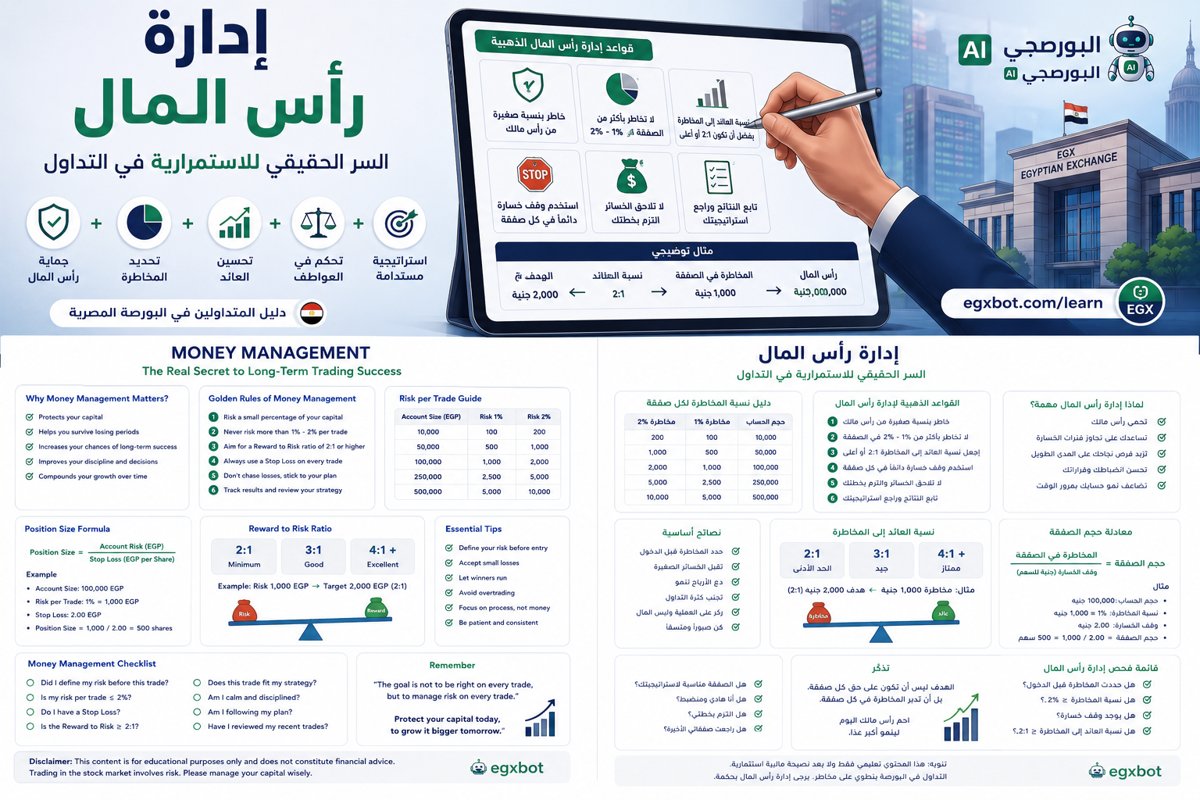
Capital management means deciding how much to risk before entering each trade so that one losing trade or a losing streak does not damage the account. Start by risking 1% or less per trade, calculate position size from the stop-loss distance, and avoid setups that do not offer a reasonable reward compared with the risk.
Capital management protects traders from the greatest market risk: losing the ability to continue. Many traders focus on stock selection or entry timing, but ignore the more important question: how much will I lose if this trade is wrong?
On the Egyptian Exchange, a stock may move quickly because of news, disclosures, low liquidity, or a change in market direction. A good idea is not enough. The potential loss must be defined and acceptable before any order is placed.
What Is Capital Management?
Capital management is a set of rules that defines how you allocate money, how much you risk per trade, where you place the stop-loss, and when you reduce or stop trading. The goal is not to avoid all losses, because losses are part of trading. The goal is to prevent the large loss that removes you from the market.
Good capital management answers five questions:
- How much capital is allocated to trading or investing?
- What is the maximum acceptable loss per trade?
- What position size matches the stop-loss distance?
- What is the maximum total risk across the portfolio?
- When should trading be reduced or paused?
A disciplined trader does not only ask how much can be made. The first question is how much can be lost if the analysis is wrong.
Why Capital Management Matters More Than Prediction Accuracy
Even skilled analysts do not win every trade. A trader can have a 50% win rate and still perform well if losses are small and winners are larger. The opposite is also true: a trader may win often but lose the account because of one oversized trade without a stop.
- It protects against large losses.
- It reduces emotional pressure.
- It allows traders to learn without destroying the account.
- It makes performance easier to measure and improve.
- It prevents over-risking after wins or losses.
The Golden Rule: Do Not Risk Too Much on One Trade
A common rule is to risk no more than 1% to 2% of account capital on one trade. For beginners, 1% or less is usually more conservative, especially in less liquid stocks or volatile markets.
| Capital | 1% Risk | 2% Risk |
|---|---|---|
| EGP 20,000 | EGP 200 | EGP 400 |
| EGP 50,000 | EGP 500 | EGP 1,000 |
| EGP 100,000 | EGP 1,000 | EGP 2,000 |
| EGP 250,000 | EGP 2,500 | EGP 5,000 |
Risk here does not mean the full trade value. It means the amount lost if the stop-loss is triggered.
Trade Value vs Actual Risk
If you buy shares worth EGP 20,000, that does not automatically mean you are risking EGP 20,000 unless you have no stop-loss or are willing to hold the stock to zero.
For example, if you buy a stock at EGP 20 and place a stop-loss at EGP 19, the risk is EGP 1 per share. If you buy 1,000 shares, the trade value is EGP 20,000, but the actual risk is EGP 1,000.
Position Size Formula
Use this formula to calculate position size:
Number of shares = Risk amount ÷ Difference between entry price and stop-loss
Then:
Trade value = Number of shares × Entry price
Practical Example
Assume your capital is EGP 100,000 and you decide to risk only 1% on the trade. The risk amount is EGP 1,000.
- Entry price: EGP 25.
- Stop-loss: EGP 24.
- Risk per share: EGP 1.
- Number of shares = 1,000 ÷ 1 = 1,000 shares.
- Trade value = 1,000 × 25 = EGP 25,000.
If the stock hits the stop-loss, the expected loss is approximately EGP 1,000, not EGP 25,000.
What If the Stop-Loss Is Far Away?
The wider the stop-loss, the smaller the position size should be. A common mistake is buying a fixed cash amount and then placing a wide stop, which creates excessive account risk.
| Entry | Stop-Loss | Risk Per Share | Risk Amount | Suitable Shares |
|---|---|---|---|---|
| EGP 25 | EGP 24.50 | EGP 0.50 | EGP 1,000 | 2,000 |
| EGP 25 | EGP 24 | EGP 1 | EGP 1,000 | 1,000 |
| EGP 25 | EGP 23 | EGP 2 | EGP 1,000 | 500 |
Choosing the Stop-Loss Correctly
The stop-loss should not always be a random fixed percentage such as 5% or 10%. It is better to place it around a technical level or a clear invalidation point.
- Below clear support.
- Below the latest higher low.
- Below a demand or accumulation zone.
- Below broken resistance after a successful retest.
- Beyond the level that invalidates the trade idea.
Reward-to-Risk Ratio
Before entering, define the possible target. If the trade risks EGP 1 per share, a target of at least EGP 2 per share creates a 2:1 reward-to-risk ratio.
Reward-to-risk ratio = Potential profit per share ÷ Potential loss per share
| Entry | Stop-Loss | Target | Risk | Reward | Ratio |
|---|---|---|---|---|---|
| EGP 20 | EGP 19 | EGP 21 | EGP 1 | EGP 1 | 1:1 |
| EGP 20 | EGP 19 | EGP 22 | EGP 1 | EGP 2 | 2:1 |
| EGP 20 | EGP 19 | EGP 23 | EGP 1 | EGP 3 | 3:1 |
The target must be realistic and based on price structure, not just optimism.
Managing Risk Across the Portfolio
Risking 1% per trade is not enough if you open ten trades that all depend on the same market direction or sector. A single negative event can affect them together.
- Limit total open risk across all trades to a defined percentage, such as 5% to 8%.
- Limit exposure to one sector according to portfolio size and strategy.
- Avoid opening several highly correlated trades.
- Keep some cash for opportunities or emergencies.
Diversification Without Overdoing It
Diversification reduces dependence on one stock, but too many holdings become difficult to monitor. Owning many stocks without a clear reason may create confusion rather than protection.
Good diversification means spreading capital across different opportunities while understanding why each position exists.
Managing Losing Streaks
Losing streaks are normal. The key is to keep them small enough so the account remains healthy.
| Account Loss | Gain Needed to Break Even |
|---|---|
| 10% | About 11.1% |
| 20% | 25% |
| 30% | About 42.9% |
| 50% | 100% |
The larger the drawdown, the harder recovery becomes. Protecting capital is more important than trying to recover losses quickly.
When to Reduce Trading Size
- After a series of losing trades.
- When market volatility rises sharply.
- Before major events if gap risk is unacceptable.
- When setups do not offer attractive reward-to-risk.
- When emotional pressure causes rule violations.
Reducing size is not weakness. Sometimes the best investment decision is to protect cash and wait for clearer opportunities.
Rules for Pausing After Losses
- After 3 consecutive losses, reduce position size by half.
- After losing 5% of the account in one week, stop opening new trades and review performance.
- If the trading plan is violated twice in one day, stop trading for the rest of the day.
These rules help prevent revenge trading.
Managing Profitable Trades
Capital management is not only about losses. It is also about protecting profits when the trade moves in your favor.
- Take partial profit at the first target.
- Move the stop-loss to breakeven after sufficient movement.
- Use a trailing stop below higher lows.
- Exit when volume or momentum weakens clearly.
- Use multiple targets instead of relying on one exit point.
Capital Management for Long-Term Investors
Long-term investors may not use stop-losses in the same way as short-term traders, but they still need capital management. They rely on position size, diversification, and reviewing the investment thesis.
- Avoid placing too much of the portfolio in one stock.
- Build positions in stages rather than all at once.
- Do not add if the company’s fundamentals deteriorate.
- Review financial results and disclosures regularly.
- Define sell conditions before buying.
Complete Trade Management Example
Assume you have an EGP 80,000 account and want to buy a stock after a resistance breakout.
- Capital: EGP 80,000.
- Risk percentage: 1%.
- Risk amount: EGP 800.
- Entry price: EGP 16.
- Stop-loss: EGP 15.20.
- Risk per share: EGP 0.80.
- Number of shares = 800 ÷ 0.80 = 1,000 shares.
- Trade value = 1,000 × 16 = EGP 16,000.
- First target: EGP 17.60.
- Reward per share: EGP 1.60.
- Reward-to-risk ratio: 2:1.
If the trade fails, the loss is about 1% of the account. If it succeeds, the potential reward is roughly twice the risk.
This example is educational and does not represent a recommendation to buy or sell any security.
Common Capital-Management Mistakes
- Using all cash in one stock: even strong analysis can fail.
- Moving the stop-loss lower: this can turn a small loss into a large one.
- Increasing size after a loss: quick recovery attempts often increase losses.
- Not calculating position size: random order value creates unclear risk.
- Ignoring liquidity: exits may not occur at the desired price.
- Opening many correlated trades: several positions may move against you together.
- Turning a failed trade into an investment: a losing trade should not become a long-term holding without a valid thesis.
- Not writing the plan: unwritten plans are easy to break.
Pre-Trade Checklist
- What is the reason for entry?
- Where is the stop-loss?
- How much will be lost if the stop is hit?
- Is the loss below the allowed limit?
- What is the correct position size?
- Where is the first target?
- Is the reward-to-risk ratio acceptable?
- Is the stock liquid enough?
- Are there other trades linked to the same sector or market direction?
- What is the plan if the trade wins or loses?
Frequently Asked Questions
Is the 1% rule suitable for everyone?
It is not mandatory, but it is a useful starting point for beginners. Experienced traders may use different levels depending on strategy, liquidity, and volatility. The key is consistency.
Is a stop-loss always necessary?
For short- and medium-term trading, a stop-loss is very important. Long-term investors may use fundamental invalidation instead, but they still need position-size limits and risk controls.
Can I recover losses by increasing the next trade size?
This is risky because it turns trading into loss-chasing. Reducing size and reviewing mistakes is usually safer than doubling risk.
How many trades can I open at once?
It depends on account size and monitoring ability. The important point is to keep total open risk within your defined limit and avoid highly correlated exposure.
Should I use the same rules for all stocks?
The principle is the same, but application differs. High-volatility or low-liquidity stocks require smaller positions and more careful stop placement.
Conclusion
Capital management is not a secondary part of trading. It is the foundation of survival. You can be wrong and still continue if the loss is small and planned. One oversized trade without a plan can erase months of progress.
Start by defining a fixed risk percentage, calculate position size from the stop-loss, avoid trades with poor reward-to-risk, and monitor total portfolio exposure. Successful trading is not only about choosing the right stock. It is about protecting capital when you are wrong.
Stock trading involves financial risk, and no method guarantees profit. This content is educational and does not constitute a recommendation to buy or sell any stock.
Calculate Risk Before Placing the Trade
Use egxbot tools to monitor charts, define entry and stop-loss levels, and review position size before trading Egyptian stocks.
This content is educational and does not constitute a direct recommendation to buy or sell. Follow a clear plan and never risk money you cannot afford to lose.
Apply it with egxbot
Get real-time analysis, signals and a bilingual AI assistant for Egyptian Exchange stocks — free to start.
Start free on Telegram