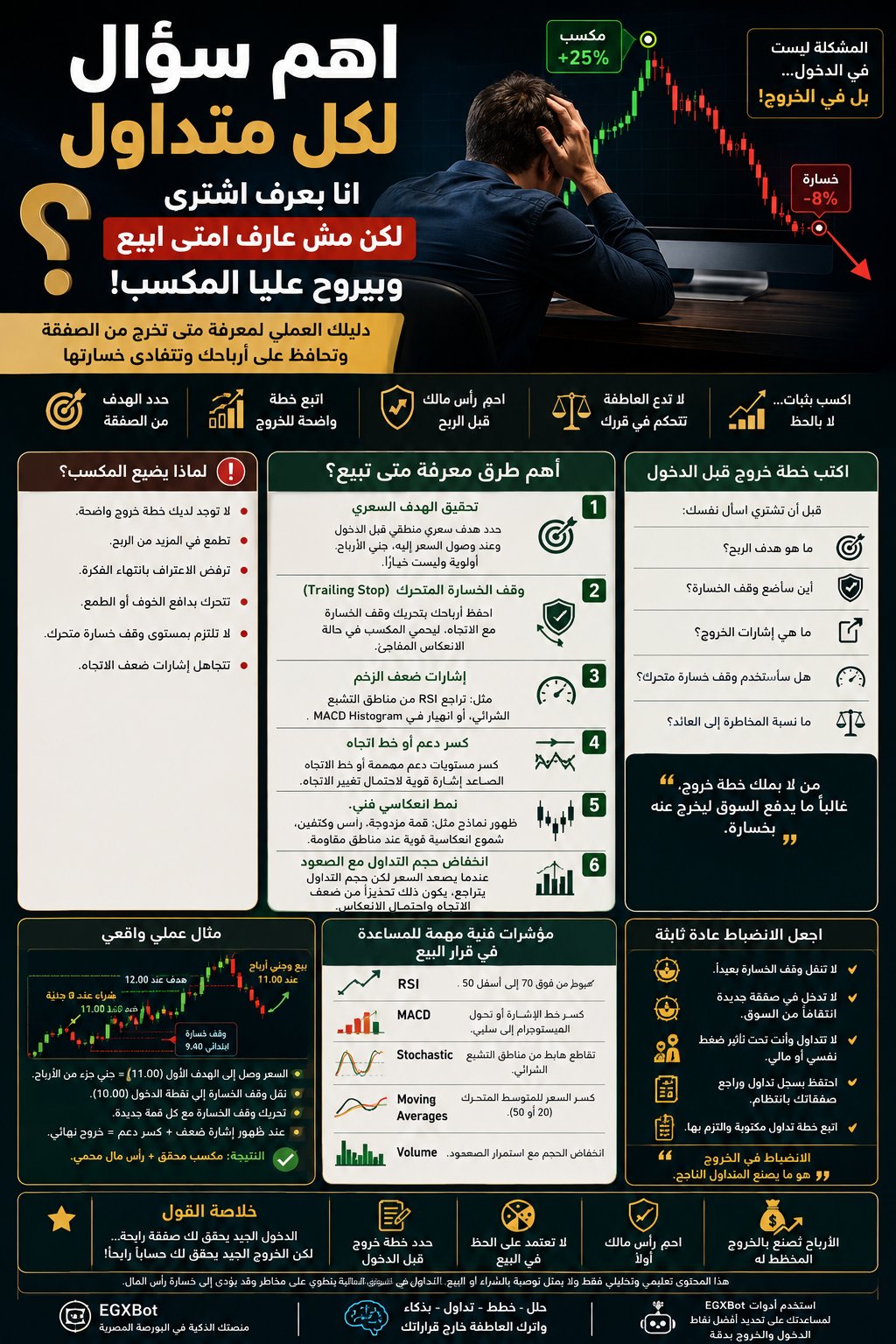
The best time to sell should be defined by a plan created before entry, not by emotions after the stock rises. Define invalidation, profit targets and a method for protecting gains if the trend continues. Exits may be triggered by major resistance, target achievement, support failure, momentum deterioration or a trailing stop. Partial profit-taking is often practical: realize part of the gain at the first target, raise the stop on the remaining shares and allow part of the position to participate in further upside.
Many traders face the same frustrating problem: they can identify good entries, watch a position move strongly into profit, and then give most or all of that profit back because they do not know when to sell.
The issue is rarely the absence of another indicator. It is usually the absence of a structured exit plan.
A good entry creates the opportunity for profit. A good exit converts that opportunity into realized profit.
Why Selling Is Harder Than Buying
Before entry, traders can objectively analyze support, resistance, breakouts, volume and reward-to-risk.
After the position becomes profitable, emotions become much stronger.
Greed
A trader enters with a 10% target, reaches it, then moves the target to 20%, then 30%.
Fear of Regret
The trader worries that selling today will be followed by another rally tomorrow.
Attachment
A successful position begins to feel like “my stock,” making objective exits more difficult.
Unrealized Profit Is Not Realized Profit
A position showing a large unrealized gain still carries market risk until the position is closed.
This does not mean every gain should be sold immediately. It means profitable positions need a method for protecting gains.
Your Exit Plan Should Begin Before Entry
Before buying, define:
- Why am I entering?
- Where is the thesis invalid?
- Where is Target 1?
- Where is Target 2?
- Will I scale out?
- When will I raise the stop?
- What conditions would force an early exit?
Two Different Reasons to Sell
The Trade Worked
- Target reached.
- Major resistance reached.
- Planned reward-to-risk achieved.
The Trade Thesis Weakened
- Support breaks.
- Trend structure changes.
- Breakout fails.
- Important news changes the thesis.
- Momentum or liquidity deteriorates materially.
Fixed Profit Targets
A simple method is to define several targets before entry.
Example
- Entry: EGP 20.
- Stop: EGP 19.
- Target 1: EGP 22.
- Target 2: EGP 24.
- Target 3: EGP 26.
Targets can be derived from resistance, previous highs, measured moves, Fibonacci extensions, Volume Profile or reward-to-risk multiples.
Using R Multiples
R represents the original risk.
If entry is EGP 20 and stop is EGP 19:
1R = EGP 1 per share.
Targets may then be structured around 1R, 2R and 3R.
Scaling Out
Partial exits solve one of the trader's biggest emotional conflicts: sell or hold?
Instead, you can do both.
Example
With 3,000 shares:
- Sell 1,000 at Target 1.
- Sell another 1,000 at Target 2.
- Keep 1,000 using a trailing stop.
This realizes profit while preserving exposure to a potentially larger move.
Trailing Stops
A trailing stop moves with a profitable trend.
It can be based on:
- Recent swing lows.
- EMA20 or MA50.
- ATR.
ATR Example
Highest price = EGP 30.
ATR = EGP 0.80.
A 2 ATR trailing stop would be:
30 − (2 × 0.80) = EGP 28.40.
Why ATR Can Be Better Than a Fixed Percentage
Different stocks have different normal volatility.
A 2% trailing stop may be suitable for a quiet stock and completely inappropriate for a volatile one.
Technical-Level Exits
Potential exit signals include:
- Major resistance.
- Important support failure.
- Trendline break.
- Failed breakout.
- Loss of a Higher Low.
Momentum-Based Exits
RSI
RSI above 70 is not an automatic sell.
More meaningful warnings include:
- Bearish divergence.
- RSI weakening while price stalls.
- Loss of the bullish RSI range combined with price weakness.
MACD
Potential warnings include:
- Bearish crossover.
- Histogram deterioration.
- Bearish divergence.
MACD should be combined with price structure because it can lag.
Volume-Based Exit Warnings
A rising price accompanied by steadily declining volume may indicate weakening participation.
Heavy volume near a major high with little price progress can be more concerning, especially when followed by upper wicks, a failed breakout or support failure.
Time Stops
Not every exit must be price-based.
If a swing trade is expected to develop within several sessions but remains stagnant for weeks while liquidity fades, capital may be better deployed elsewhere.
Market and Sector Conditions
A stock should not be analyzed in isolation.
If the broad market or the stock's sector deteriorates sharply, traders may reduce exposure, tighten trailing stops or realize more profit.
Fundamental Thesis Changes
An exit may also be justified when material information changes the original investment thesis.
Examples include:
- Unexpectedly weak earnings.
- Major financing problems.
- Regulatory developments.
- Cancellation of a major transaction.
Preventing a Large Winner from Becoming a Loser
As the trade moves further in your favor, the way you manage risk should normally evolve.
A position that once risked 1R should not necessarily continue carrying the same downside after reaching 2R or 3R in profit.
Do Not Suffocate the Trade
The opposite mistake is moving the stop too close after a small gain.
Normal pullbacks can then exit a healthy trend before the larger move develops.
Stops should respect:
- Price structure.
- Volatility.
- Timeframe.
- Trading strategy.
The Breakeven Trap
Moving a stop to breakeven immediately after a small gain may feel safe but often produces unnecessary exits.
A more logical time to reduce risk may be after:
- A meaningful breakout.
- A new Higher Low.
- A predefined R multiple.
When Should You Let a Winner Run?
- Higher highs and higher lows remain intact.
- Volume supports advances.
- No major resistance is nearby.
- Relative strength remains strong.
- The broad market supports the move.
- No major bearish divergence appears.
When Should Profit Protection Become More Aggressive?
- Major historical resistance.
- Extremely extended move.
- Climactic volume.
- Bearish divergence.
- Failed breakout.
- Loss of the latest Higher Low.
- Broad market weakness.
Complete Exit Example
A trader buys 3,000 shares at EGP 20.
The plan:
- Stop: EGP 19.
- Target 1: EGP 22.
- Target 2: EGP 24.
- Target 3: Open using a trailing stop.
At EGP 22, 1,000 shares are sold.
The stop on the remaining shares is raised if price structure allows.
At EGP 24, another 1,000 shares are sold.
The final 1,000 shares continue with a trailing stop below rising swing lows.
This approach locks in profit while retaining exposure to a larger trend.
Maximum Favorable Excursion — MFE
MFE measures the maximum unrealized profit achieved while a trade was open.
Example
Entry: EGP 20.
Maximum price reached: EGP 25.
Exit: EGP 21.
The trade achieved a 25% MFE but only a 5% realized return.
If this pattern repeats frequently, the exit methodology likely needs improvement.
Profit Giveback
A useful review metric is:
Profit Giveback = Maximum Favorable Excursion − Realized Return
The goal is not zero giveback. Perfectly selling tops is unrealistic.
The goal is avoiding consistently giving back most of large profitable moves.
Adapt the Exit Style to the Trader
Conservative Trader
- Closer targets.
- Larger partial exits.
- Tighter trailing stops.
Trend Follower
- Smaller partial exits.
- More room for normal volatility.
- Exit after major swing-low or moving-average failure.
Day Trader
More attention may be placed on:
- VWAP.
- Intraday support.
- High of Day.
- Volume.
- Time remaining in the session.
A Structured Exit Framework
| Stage | Action |
|---|---|
| Before entry | Define stop, T1 and T2 |
| At +1R | Review whether to reduce risk or take partial profit |
| At Target 1 | Realize part of the gain |
| After new Higher Low | Raise trailing stop |
| At Target 2 | Take additional profit |
| Trend continues | Keep a runner |
| Trend structure breaks | Exit remaining position |
You Do Not Need to Sell the Exact Top
If you buy at EGP 20 and sell at EGP 28 before the stock reaches EGP 30, you did not “lose” EGP 2.
You realized a strong gain according to your process.
Professional trading is not about capturing every last tick.
Common Exit Mistakes
- No exit plan.
- Constantly moving targets higher.
- Greed after reaching the original target.
- Fear of regret after selling.
- Allowing most profit to disappear.
- Moving stops farther away.
- Never using a trailing stop.
- Refusing to scale out.
- Relying on one indicator.
- Ignoring market weakness.
- Becoming emotionally attached to the stock.
- Trying to sell the exact high.
How EGXBot Can Help
- Track multiple profit targets.
- Monitor swing lows and moving averages.
- Identify RSI and MACD deterioration.
- Monitor volume and liquidity.
- Create alerts around resistance and stop levels.
- Calculate ATR-based trailing stops.
- Review saved trade performance.
Useful AI Assistant Questions
- I entered at X and am up Y%. Should I consider taking partial profit?
- What are the nearest major resistance levels?
- Where is a logical trailing stop?
- Is the Higher High / Higher Low structure still intact?
- Does volume still confirm the rally?
- Is there bearish RSI or MACD divergence?
- Calculate 1.5 ATR and 2 ATR trailing stops.
- Should I scale out or continue holding the full position?
- Is the stock excessively extended from MA20 or MA50?
Pre-Exit Checklist
- Has a predefined target been reached?
- Is price at major resistance?
- Is the uptrend intact?
- Does volume support the move?
- Is there bearish divergence?
- Has the broad market weakened?
- Is price excessively extended?
- Can I sell only part of the position?
- Where is the current trailing stop?
- How much profit will be given back if the stop triggers?
- Am I following the plan or reacting emotionally?
Conclusion
A trader who knows how to buy but does not know how to sell has only half a trading strategy.
Professional exits are not about predicting the exact market top.
They are about knowing when to realize part of a gain, when to let a winner continue, when to raise the stop and when the original trade thesis has changed.
Use fixed targets when levels are clear, partial exits when you want to balance certainty with further upside, and trailing stops when the objective is to ride a trend.
The objective is not to sell at the highest possible price. The objective is to exit in a way that preserves capital, captures meaningful profit and allows you to continue trading the next opportunity.
This content is educational and does not constitute investment advice. Exit rules should be adapted to strategy, timeframe and individual risk tolerance.
Profits Are Protected by an Exit Plan — Not by Hope
Use EGXBot to monitor targets, resistance, volume, momentum deterioration and trailing stops so that changing market conditions do not turn into delayed emotional decisions.
Do not try to sell the exact top. Focus on repeatable profit capture, capital protection and allowing part of successful positions to continue when the trend remains healthy.
This content is educational and does not constitute investment advice.
Apply it with egxbot
Get real-time analysis, signals and a bilingual AI assistant for Egyptian Exchange stocks — free to start.
Start free on Telegram